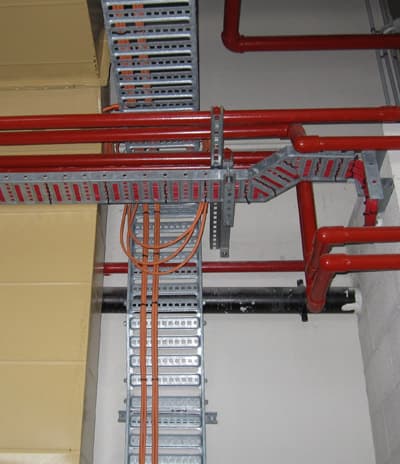
Straight perforated cable trays are designed to support and manage electrical cables in a safe, organized, and efficient manner across a variety of applications including industrial plants, solar installations, commercial buildings, and infrastructure projects. These trays help in routing power and data cables while offering protection and easy access for maintenance and upgrades.
Cable trays are available in straight sections and come in two main configurations: perforated and solid (non-perforated). Perforated trays allow for better ventilation, which reduces heat buildup around the cables, and they also make cable fastening easier. Solid trays are used where cable protection from dust, debris, and moisture is a priority.
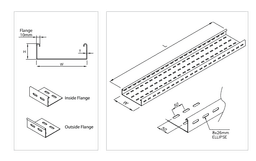
Standard widths for these trays include 50 mm, 100 mm, 150 mm, 200 mm, 300 mm, 400 mm, 500 mm, 600 mm, and 900 mm. Side heights are available in 35 mm, 50 mm, 75 mm, and 100 mm. Tray thickness options range from 1.0 mm to 2.5 mm (including 1.2 mm, 1.3 mm, 1.5 mm, and 2.0 mm). Lengths typically come in 1.5 m, 2.0 m, 2.44 m, and 3.0 m segments.
Material choices include GI (pre-galvanized steel), HDG (hot-dip galvanized steel), AL (aluminum), and SS (stainless steel). Each material is selected based on the environment and corrosion resistance requirements. Pre-galvanized steel is commonly used for indoor applications. Hot-dip galvanized trays are suitable for outdoor and industrial use due to their robust corrosion resistance, following the BS:EN 1461 standard. Aluminum trays are lightweight and corrosion-resistant, ideal for coastal or chemical environments. Stainless steel trays are used in aggressive, high-corrosion, or hygienic areas such as food processing plants.
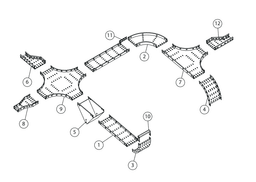
The trays are joined using splice plates—available in normal, expansion, or adjustable types. They are mounted and fixed with hold-down clamps and supported by brackets or other structural supports depending on the installation (wall-mounted, floor-mounted, or suspended from ceilings).
Perforation class shown is B-class based on area coverage, but C-class or custom perforation patterns can also be provided on request. Custom dimensions and coating thicknesses can also be manufactured based on project specifications.
When trays are cut in the field, any exposed metal should be treated with a zinc-rich compound to protect against corrosion and maintain long-term durability.